
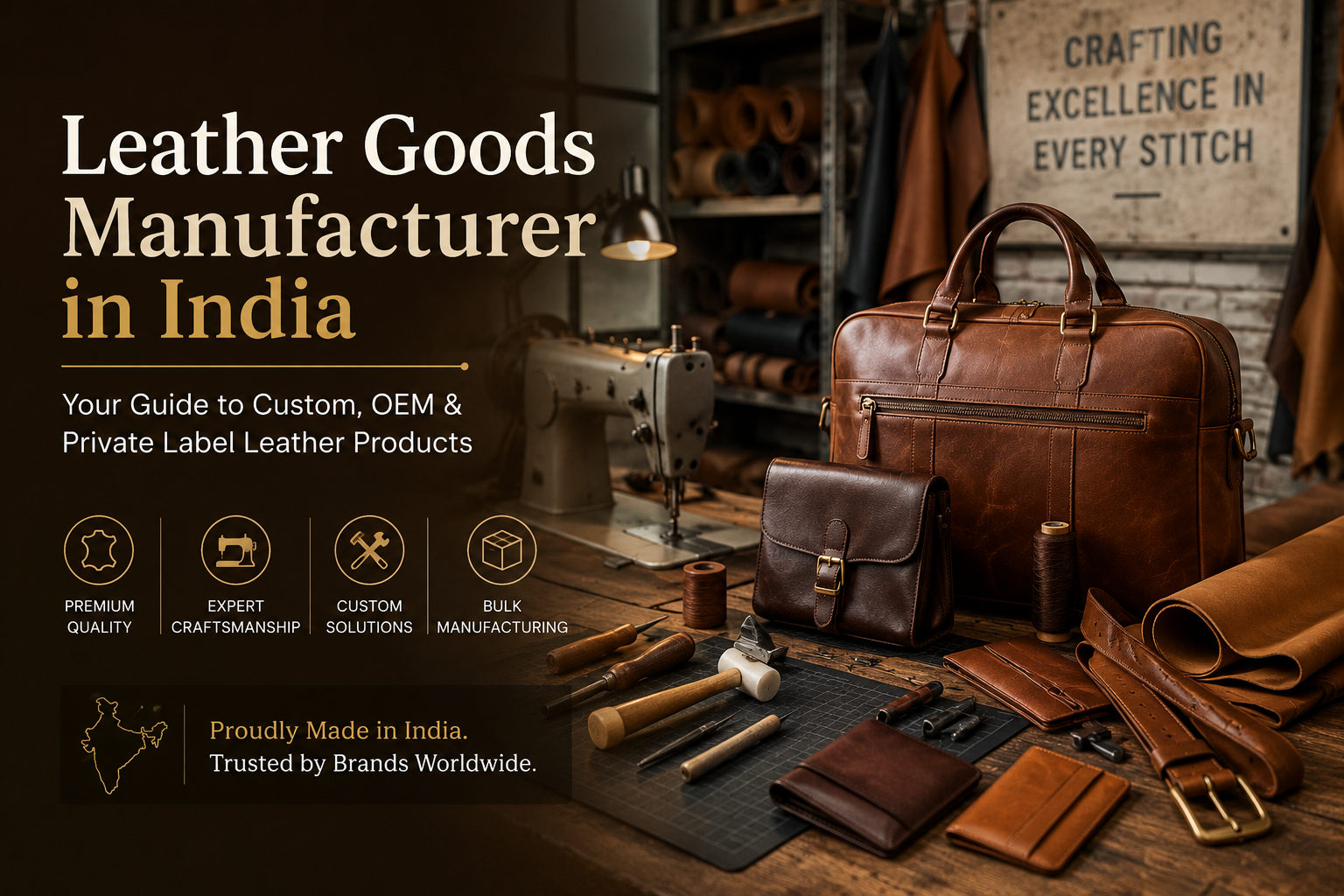
Choosing a leather goods manufacturer in India is not simply about finding a supplier that can make bags, wallets or belts at an attractive price. For brands and B2B buyers, the real challenge is finding a manufacturing partner that can understand the product, develop accurate samples, maintain quality during bulk production and reproduce the approved specifications when you reorder.
India has an established leather and leather-products manufacturing ecosystem serving domestic and international markets. For fashion brands, retailers, wholesalers, e-commerce businesses, importers and corporate buyers, this creates opportunities to source custom leather goods through OEM, private-label and bulk manufacturing arrangements.
This guide explains what to evaluate before choosing a manufacturer, how custom leather manufacturing works, what affects pricing and how to prepare your requirements before requesting a quotation.
What Does a Leather Goods Manufacturer Do?
A leather goods manufacturer converts a design, product concept, reference sample or technical specification into finished products at commercial scale.
Depending on the manufacturer's capabilities, the process may include:
- Material sourcing
- Product development
- Pattern and prototype development
- Sampling
- Cutting and skiving
- Stitching and assembly
- Hardware installation
- Edge finishing
- Branding
- Quality inspection
- Packaging
- Bulk production
For a B2B buyer, this distinction matters. A manufacturer is not necessarily just a wholesaler selling existing inventory. In custom and OEM manufacturing, the factory can become part of the brand's product-development and supply chain.
Typical product categories include leather handbags, laptop bags, wallets, card holders, belts, jackets, small accessories, corporate gifts and other customized leather products.
Why Do Brands Source Leather Goods From India?
India has an established leather and leather-products industry with manufacturing centres across multiple states. The Council for Leather Exports (CLE), functioning under India's Ministry of Commerce & Industry, is the notified export-promotion organisation for the country's leather and leather-products industry.
For buyers, however, the strength of the overall industry is only the starting point. The more important question is whether the individual leather products manufacturer in India can meet your specific product, quality, quantity, branding and delivery requirements.
Access to Multiple Product Categories
Brands often need more than one product.
A lifestyle or business-accessories collection, for example, could include:
- Handbags
- Laptop bags
- Wallets
- Card holders
- Belts
- Travel accessories
- Corporate gifts
A manufacturer capable of working across related categories can make collection development easier and help maintain a consistent approach to materials, colours, hardware and branding.
Custom Product Development
Custom manufacturing gives a brand control over more than its logo.
Depending on the product and manufacturing capabilities, customization can include dimensions, leather selection, colours, lining, stitching, compartments, hardware, zippers, closures, embossing, logo placement and packaging.
This makes custom manufacturing particularly relevant for brands that want differentiated products rather than generic wholesale inventory.
OEM, Private Label and Custom Leather Manufacturing: What's the Difference?
These terms are often used together, but they describe slightly different sourcing models.
|
Manufacturing Model |
Best For |
Typical Requirement |
|
Custom Manufacturing |
Brands creating distinctive products |
Product developed around buyer requirements |
|
OEM Manufacturing |
Buyers with defined designs/specifications |
Production according to agreed specifications |
|
Private Label |
Businesses selling under their own brand |
Buyer branding, labels and packaging |
|
Wholesale/Bulk |
Retailers and volume buyers |
Existing or agreed products in larger quantities |
Custom Leather Manufacturing
A custom leather products manufacturer can work from sketches, technical drawings, measurements, reference samples or detailed product briefs.
For example, a brand may request a laptop bag with its own dimensions, internal compartments, lining, shoulder strap, hardware finish, leather colour and branding.
OEM Leather Manufacturing
OEM manufacturing is generally suitable when the buyer already has relatively clear product requirements.
The manufacturer produces according to agreed specifications covering details such as materials, dimensions, construction, hardware, branding and packaging.
For OEM production, these details should be documented rather than communicated only through photographs or informal messages.
Private-Label Leather Manufacturing
Private-label leather manufacturing allows a business to sell products under its own brand while manufacturing is handled by a third party.
Depending on the project, private-label customization may include logos, embossing or debossing, labels, colours, hardware, boxes, dust bags and other packaging.
It can be particularly useful for retailers, D2C businesses and e-commerce brands that want a branded leather collection without operating their own manufacturing facility.
What Leather Products Can Brands Manufacture?
The exact product range depends on the factory's expertise, equipment and sourcing network, but common categories include:
Leather Bags and Handbags
A leather bag manufacturer may produce handbags, totes, crossbody bags, travel bags and other fashion or functional designs.
Buyers should define important specifications such as dimensions, leather, lining, reinforcement, handles, straps, pockets, hardware, zippers, stitching and logo application.
Explore MadMenWork's leather handbags for examples from this category.
Leather Laptop and Business Bags
Laptop bags require both appearance and functionality. Buyers may need to specify laptop compartment dimensions, padding, internal organisation, handles, shoulder straps and closures.
See MadMenWork's leather laptop bags for relevant product options.
Wallets, Belts and Leather Accessories
Small leather products can include wallets, card holders, passport covers, belts, organisers and other accessories.
Even simple-looking products require attention to stitching, edge finishing, symmetry, thickness, hardware and branding.
Brands building this category can explore leather accessories.
Leather Jackets
Leather apparel requires additional attention to patterns, sizing, fit, lining and garment construction.
Businesses interested in this category can review leather and biker jackets.
Corporate Leather Gifts
Leather goods can also be developed for corporate gifting, including wallets, organisers, laptop bags, accessories and customized gift sets.
Explore leather corporate gifts and premium leather gifting for this category.
How Does Custom Leather Manufacturing Work?
A professional manufacturing project should move through defined stages rather than jumping directly from a reference image to bulk production.
1. Create the Product Brief
Start by defining:
- Product category
- Reference images or sketches
- Dimensions
- Intended customer or market
- Leather preference
- Colour
- Hardware
- Lining
- Branding
- Packaging
- Expected quantity
- Required timeline
Not every detail needs to be finalized initially. However, confirmed requirements should be clearly separated from decisions that still require development.
2. Select Materials and Components
Leather is only one component of the finished product.
Depending on the design, buyers may also need to select lining, thread, zippers, buckles, rivets, closures, reinforcement, labels and packaging.
Two bags that look similar externally can therefore have significantly different manufacturing requirements.
3. Develop and Review the Sample
Sampling allows the buyer and manufacturer to evaluate the product before bulk production.
Review dimensions, construction, materials, functionality, hardware, stitching, edge finishing and branding.
The first sample may require changes to strap length, pockets, logo size, hardware, colour or other details. Document these revisions clearly.
4. Approve the Final Specification
Before bulk production, establish a clear production reference.
This can include the approved physical sample together with documented specifications for dimensions, materials, hardware, colour, branding and packaging.
This step helps reduce ambiguity when production begins.
5. Bulk Production and Quality Control
After approval, manufacturing moves into production.
Quality inspection should compare finished products against agreed requirements rather than subjective descriptions such as "premium quality."
Depending on the product, checks can include:
- Dimensions
- Stitch consistency
- Leather appearance
- Hardware
- Zippers and closures
- Edge finish
- Logo placement
- Lining
- Functionality
- Packaging
6. Packaging and Dispatch
Packaging requirements should be confirmed before production is completed.
Private-label brands may require dust bags, boxes, labels, barcodes or product inserts. International buyers should also clarify shipping responsibilities and documentation with their supplier and logistics partners.
How to Choose a Leather Goods Manufacturer in India
The best manufacturer is not necessarily the supplier with the largest catalogue or lowest quotation. The right partner is one whose capabilities match your product and commercial requirements.
Check Relevant Product Experience
Look for experience with the product you actually want to manufacture.
A supplier experienced in belts is not automatically the right manufacturer for structured handbags or jackets.
Evaluate Product-Development Capability
For custom products, determine whether the manufacturer can interpret your sketches, references and specifications and turn them into a manufacturable product.
A capable supplier should ask questions when important information is missing rather than making assumptions.
Understand the Sampling Process
Ask how sampling works, what information is required, how revisions are managed and what constitutes final approval.
A structured sampling process can prevent misunderstandings during bulk production.
Discuss MOQ Early
There is no universal MOQ for every leather product.
Minimum order quantity can vary according to product complexity, materials, colours, hardware, packaging and manufacturing setup.
Tell the manufacturer your expected volume early and ask what is feasible for that particular product.
Confirm Capacity and Lead Time
Discuss sample development time, material procurement, bulk-production lead time, packaging and repeat-order capacity before setting a launch date.
Manufacturing capability does not always mean immediate production availability.
Verify Important Claims
If certifications, testing, material traceability, social-compliance programmes or export credentials are important to your business, request current supporting documentation and verify its scope.
Do not rely solely on badges displayed on a website.
What Determines the Cost of Custom Leather Products?
There is no meaningful universal price for custom leather goods because manufacturing cost depends on the specification.
Important cost drivers include:
- Leather type and finish
- Material consumption
- Product dimensions
- Construction complexity
- Hardware and zippers
- Lining and reinforcement
- Stitching and finishing
- Branding method
- Custom components
- Packaging
- Order quantity
- Sampling and development
When comparing manufacturers, provide substantially the same specifications to each supplier.
Otherwise, a lower quotation may simply represent different materials, components or construction.
RFQ Checklist: What Should You Send a Leather Manufacturer?
A well-prepared Request for Quotation helps manufacturers understand your project and provide a more relevant response.
Before contacting a leather product supplier in India, prepare:
- Product category
- Sketches or reference images
- Dimensions
- Preferred material
- Colour
- Lining
- Hardware
- Branding method
- Packaging requirements
- Estimated quantity
- Number of colours or SKUs
- Target market
- Required timeline
- Sample requirements
- Testing or compliance requirements, where applicable
If some details are unknown, identify them clearly. A capable product-development team can then determine what needs to be decided before sampling.
Common Mistakes When Sourcing Leather Goods
Choosing Only on Price
Compare the complete offer rather than the unit price alone.
Materials, construction, components, development support, packaging, quality expectations and delivery terms all matter.
Starting Production Before Sample Approval
A photograph is not a substitute for properly evaluating the product.
Approve the sample and document agreed revisions before authorizing bulk production.
Using Vague Requirements
Instructions such as "premium leather," "good hardware" or "medium-sized bag" are subjective.
Use dimensions, material specifications, approved references and clearly documented requirements wherever possible.
Ignoring Components Other Than Leather
Zippers, lining, thread, reinforcement, hardware and edge finishing can strongly influence the appearance and functionality of the finished product.
Evaluate the complete construction.
Forgetting About Repeat Orders
If the first production run succeeds, you may need the same product again months later.
Maintain references for dimensions, materials, colours, patterns, hardware, branding and packaging so repeat production has a clear benchmark.
When Is Private-Label Leather Manufacturing the Right Choice?
Private-label manufacturing can be suitable when you want to build a branded leather collection without operating your own factory.
It is particularly relevant when:
- You want your own branding and packaging
- You need customization
- You sell through retail or e-commerce
- You want a coordinated product collection
- You expect repeat production
- In-house manufacturing is not practical
However, if you need only a small number of generic products immediately and customization is unimportant, existing wholesale inventory may be more appropriate.
A Simple Framework for Shortlisting Manufacturers
Rather than choosing a supplier based on one factor, compare candidates across several areas.
|
Evaluation Area |
What to Check |
|
Product Capability |
Relevant experience with your category |
|
Development |
Ability to interpret and refine specifications |
|
Sample |
Construction, finishing and functionality |
|
MOQ |
Compatibility with your business model |
|
Capacity |
Ability to handle expected volumes |
|
Quality Process |
How production is checked |
|
Communication |
Clarity and documentation |
|
Lead Time |
Fit with launch and replenishment plans |
|
Repeatability |
Ability to reproduce approved products |
|
Commercial Fit |
Overall value, not price alone |
The weighting can change according to your business.
A startup may prioritize development support and workable order quantities, while an established importer may prioritize capacity, consistency and repeat-order reliability.
Frequently Asked Questions
How do I choose a leather goods manufacturer in India?
Choose a manufacturer with relevant experience in your product category, then evaluate its sampling process, materials, MOQ, capacity, quality controls, lead times and communication. For custom products, approve a sample and document the final specification before bulk production.
What is private-label leather manufacturing?
Private-label manufacturing means a third-party manufacturer produces leather goods that are sold under the buyer's brand. Depending on the arrangement, products can include custom logos, labels, colours, packaging and other brand-specific details.
What is OEM leather manufacturing?
OEM leather manufacturing generally means producing products according to specifications defined or approved by the buyer. These may cover dimensions, materials, construction, hardware, branding and packaging.
What is the MOQ for custom leather products?
There is no single MOQ applicable to all leather goods. Minimum quantities depend on factors such as product type, materials, colours, hardware, packaging and production setup. Request an MOQ for your specific product and specification.
How much do custom leather products cost in India?
Cost depends on leather, dimensions, material consumption, construction, hardware, lining, branding, packaging, quantity and development requirements. An accurate quotation normally requires a sufficiently detailed product brief.
Can manufacturers make leather products from my design?
Manufacturers offering custom development may work from sketches, technical drawings, reference products or detailed briefs. The design should normally go through sampling and approval before bulk manufacturing.
Can I add my own logo and packaging?
Private-label manufacturers may provide branding and packaging customization depending on their capabilities and the product. Logo method, dimensions, placement and packaging specifications should be agreed during development.
Final Takeaway
Finding the right leather goods manufacturer in India is ultimately about matching manufacturing capability with your product and business requirements.
For custom, OEM and private-label sourcing, focus on five fundamentals:
- Relevant capability: Can the manufacturer produce your type of product?
- Clear specifications: Are materials, construction, dimensions and branding defined?
- Sample approval: Has the product been properly evaluated before production?
- Production consistency: Can the approved standard be reproduced across bulk and repeat orders?
- Commercial fit: Do MOQ, lead time, capacity and overall cost work for your business?
A structured sourcing process gives both buyer and manufacturer a clearer foundation for product development, production and future reorders.
If your business is exploring custom leather products, OEM manufacturing, private-label leather goods or bulk production in India, MadMenWork works across leather bags, wallets, belts, accessories, gifting products and related categories.
Explore MadMenWork and share your product concept, references, expected quantity and customization requirements to start a manufacturing discussion